
Nobody realizes these are not normal jeans
I Refused to Dress Like a Power Ranger Just to Ride to Work. So I Found the Cargos Nobody Clocks as Armor — for $69, Not $500.
For years I rode in normal jeans because every "safe" option looked like a costume, cooked me in traffic, or cost as much as the bike payment. Turns out I was choosing wrong — and so are most riders.

For two years I rode to work in supermarket jeans, under a suit jacket, and I told myself it was a decision. It wasn't. It was avoidance dressed up as one — and I only understood that the day I saw what the alternative actually looked like.
Let me set the scene, because if you commute to an office on a bike you already know it in your bones. I have meetings. A lanyard. A desk in an open-plan floor where nobody else rides. I cannot walk into a 9 a.m. stand-up in full leathers and a race suit. I'd get laughed out of the lift, and I'd spend the first ten minutes of every meeting peeling armor off in front of people who don't ride and don't want to hear about it.
So the "proper" gear — the stuff that actually protects you — was never realistic for my life. And the industry's supposed compromise, armored jeans, wasn't much better: hot, stiff, visibly padded at the knee, and starting at two hundred pounds for anything with a real rating. On me, sitting down at a desk, they announced "this man rides a motorbike" the second I crossed my legs.
So I did what I suspect most desk-job riders quietly do. I wore my normal jeans, kept my speed sensible, and decided the risk was small enough to ignore. Wear normal clothes. Cross your fingers. Deal with it if it ever happens. That was the plan, if you can call it one.
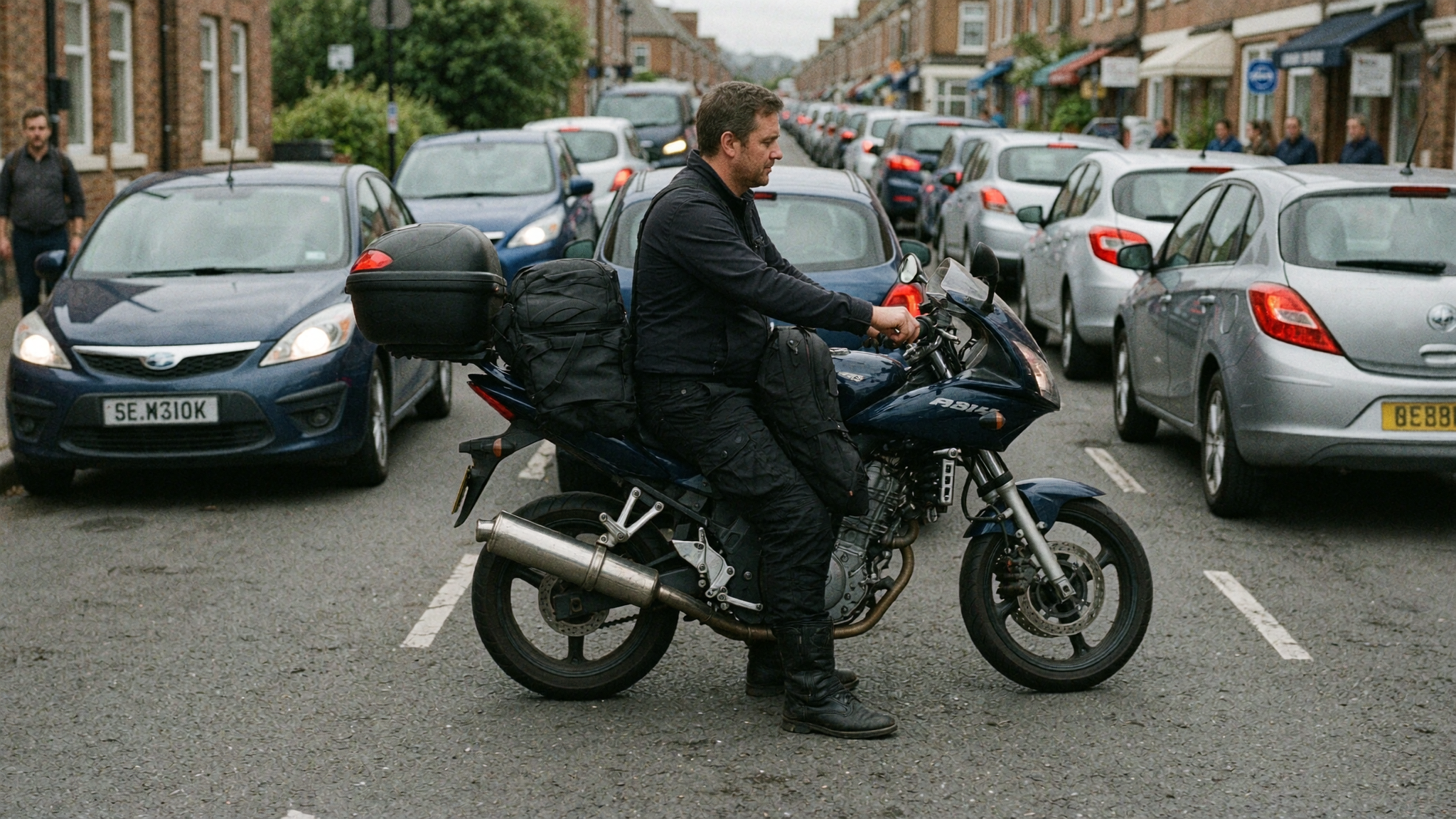
Why "it's only the commute" is exactly the wrong thing to think
Here's what makes that logic so dangerous: from the inside, it doesn't feel reckless. It feels reasonable. The commute is short. The roads are familiar. You're not doing anything stupid. And most days, it's completely fine — which is precisely how it teaches you the wrong lesson.
Because the crash that actually happens to commuters isn't the dramatic one. It's the low-side at a wet junction. The diesel on a roundabout. The car that turns across you at twenty miles an hour outside the retail park. And the thing nobody explains is that the danger was never really about speed at all. It's about friction. The instant you and the tarmac are sliding against each other, ordinary denim has almost no abrasion resistance — it isn't woven to resist a road, it's woven to look good in a pub. So it doesn't heroically tear. It disappears, and your skin becomes the next layer.
0.6 seconds versus seven. That is the entire argument, and it doesn't care that you were "only nipping to the office." Twenty miles an hour across tarmac is still your skin being sanded down — the speed just decides how far you travel while it happens.
The false choice the whole market is built on
For years I genuinely believed there were only two options, and both were bad. Option one: full protection that looks like protection — leathers, armor, the track-day look. Brilliantly safe, and completely incompatible with walking into a meeting or standing at a bar. Option two: look normal and accept you're basically unprotected.
Every rider I know who commutes has made peace with some version of that choice. And here's the quiet tragedy of it: the choice itself is the thing that gets people hurt. Because gear you're slightly embarrassed to wear is gear you talk yourself out of. Every single time. The best armor in the world protects nobody if it's hanging on a hook at home because it was too much faff for a Tuesday.
I had exactly that setup, in fact. One good armored jacket, saved for "proper" rides. The commute never counted as a proper ride in my head, so I did it in jeans. The gear that could have saved my skin spent most of its life on a peg. That's not a gear problem. That's a design problem the whole industry had refused to solve.

Then a bloke two desks over changed my mind without trying to
Quiet chap. Marketing. Rides a little Honda. One Monday he turned up in a pair of cargos I genuinely could not tell apart from any other pants on the floor. Sat down. Worked all day. I only found out anything had happened because I overheard him telling someone he'd come off at the weekend.
Come off. And walked into the office on Monday.
At lunch I asked him about it. He pulled the fabric round at the knee and showed me a grey scuff — no tear, no hole, no drama. Then he told me the part that quietly reorganised everything I thought I knew: they were Class AA certified. CE armor at the knees and hips, sitting in slim internal pockets. Cordura built into the slide zones. And from the outside — nothing. No tactical panels. No armor bulge. No "gear" look at all. He'd been wearing them into the office for months, and not one person — including me, and I look for this stuff — had ever clocked them.
The feature that actually matters isn't the one you'd guess
That lunch reorganised my thinking, because it exposed the thing I'd had backwards for two years. I'd been treating "I don't want to look like I ride" as vanity — a slightly shameful preference I had to weigh against safety. It isn't vanity. It's the entire mechanism. If gear looks and feels like normal clothes, you'll actually put it on for the boring ten-minute ride. If it looks like a costume, you won't. And the ten-minute ride is exactly where the crash lives.
Which means the single most important feature of protective gear is not its armor rating. It's whether you will wear it, every time, without thinking. Everything else is theory. A garment that scores brilliantly in a lab and lives on a peg has a real-world protection score of zero. The industry spent decades optimising the lab number and ignoring the only number that saves anyone.
EN 17092 is the European standard for motorcycle clothing. It grades garments A, AA and AAA by how they survive a defined abrasion, tear and seam-strength test, with impact armor at the knees and hips. AA is the grade built for real-world road speeds — commuting, town, A-roads, up to around 40 mph. A pair of jeans with a "CE" tag sewn in and no certificate number behind it has passed none of that. The tag is decoration. Always ask for the certificate.
The $69 that I was sure had to be a catch
The brand my colleague pointed me to is Bastion. I went home and looked them up half-expecting to catch the trick, because everything about it sounded too good: certified protection, in pants that look completely normal, for fifty-nine quid when the pairs I'd trusted cost triple that or more.
So I did the suspicious thing and read the paperwork. Class AA to EN 17092, with the certificate and test report actually published — not a swing tag, the real document. Cordura at the knees, hips and seat, the three points that hit and slide. CE armor at the joints. Single-layer four-way stretch, so no sauna at a desk all day and no waddle when you walk. Ten-pocket cargo cut that reads as ordinary. And the $69.99 turned out to be a launch price against a $139.99 RRP — not a reflection of the grade, just an introductory number to get them on riders' legs.
The reason it can be a fraction of the $350–$550 names is the part the premium market would rather you didn't work out: a lot of that price is a race-heritage badge and an AAA over-spec built for sustained track speeds most of us will never ride. For the riding I actually do — a commute and the odd weekend blast — Class AA is exactly the grade the standard specifies. I wasn't getting less protection for my riding. I was just not paying four hundred quid for a scenario that isn't mine.

What actually changed once I had them on
I ordered a pair mostly to test whether "nobody realizes" was marketing or true. It's true. I've worn them into meetings, to lunch, to the pub after work, on the school run. Not one person has ever said a word — because there's nothing to say a word about. They're pants. They just happen to be the pants I'd want on if the car at the roundabout doesn't see me.
And the quiet irony is that the feature I now value most isn't the armor at all. It's that they look like nothing. Because that's the feature that finally let me stop choosing between looking normal and being covered — the choice I'd been losing, badly and silently, for two years. I don't gear up for "proper" rides anymore. I just get dressed, and I happen to be protected, and the ten-minute rides that used to be my biggest exposure are now the same as every other ride.
If you're a desk-job rider making the same trade I was — normal clothes, fingers crossed, telling yourself the short ones don't count — this is the piece I wish someone had put in front of me two years earlier.
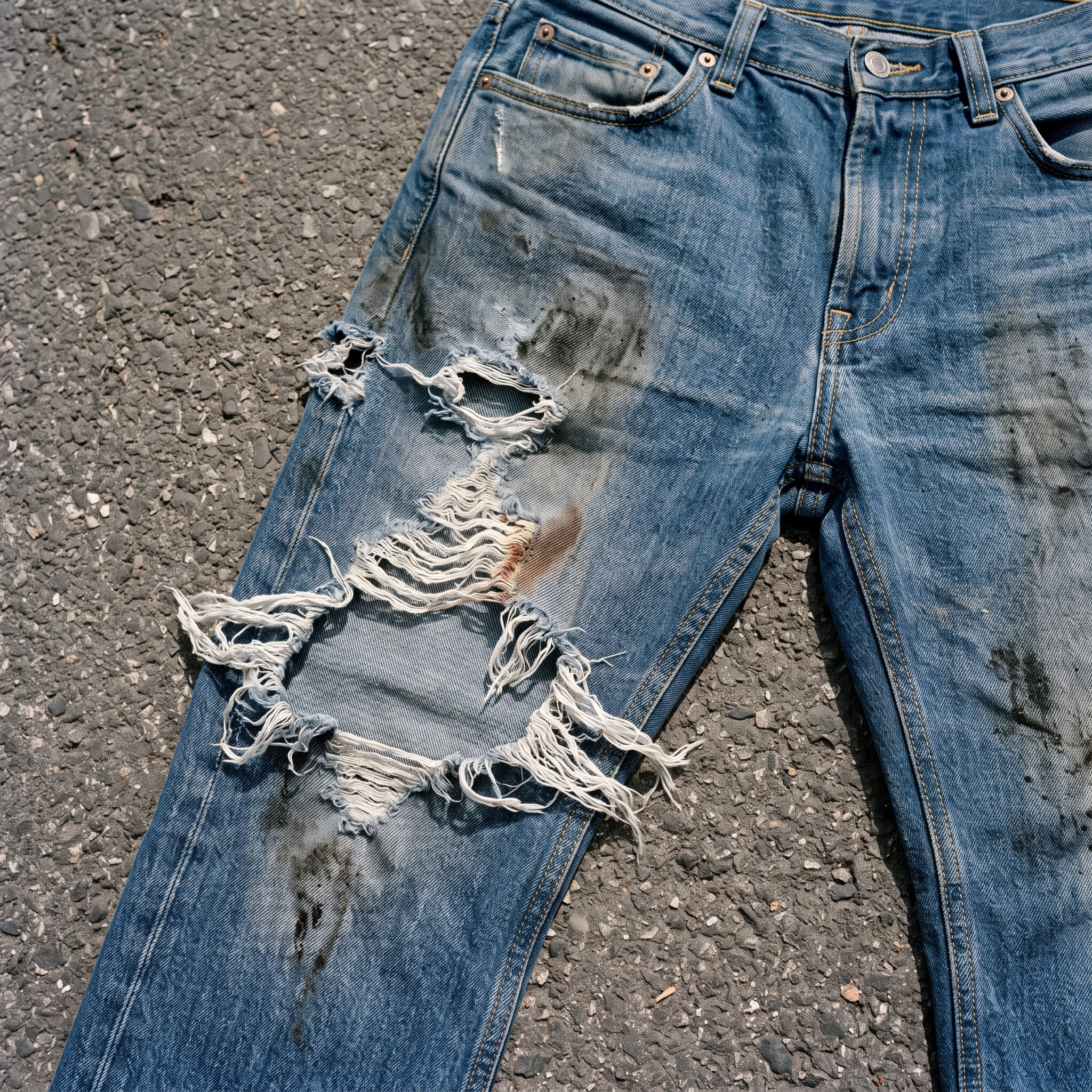
Through to skin in 0.6 s. Binned at the roadside.
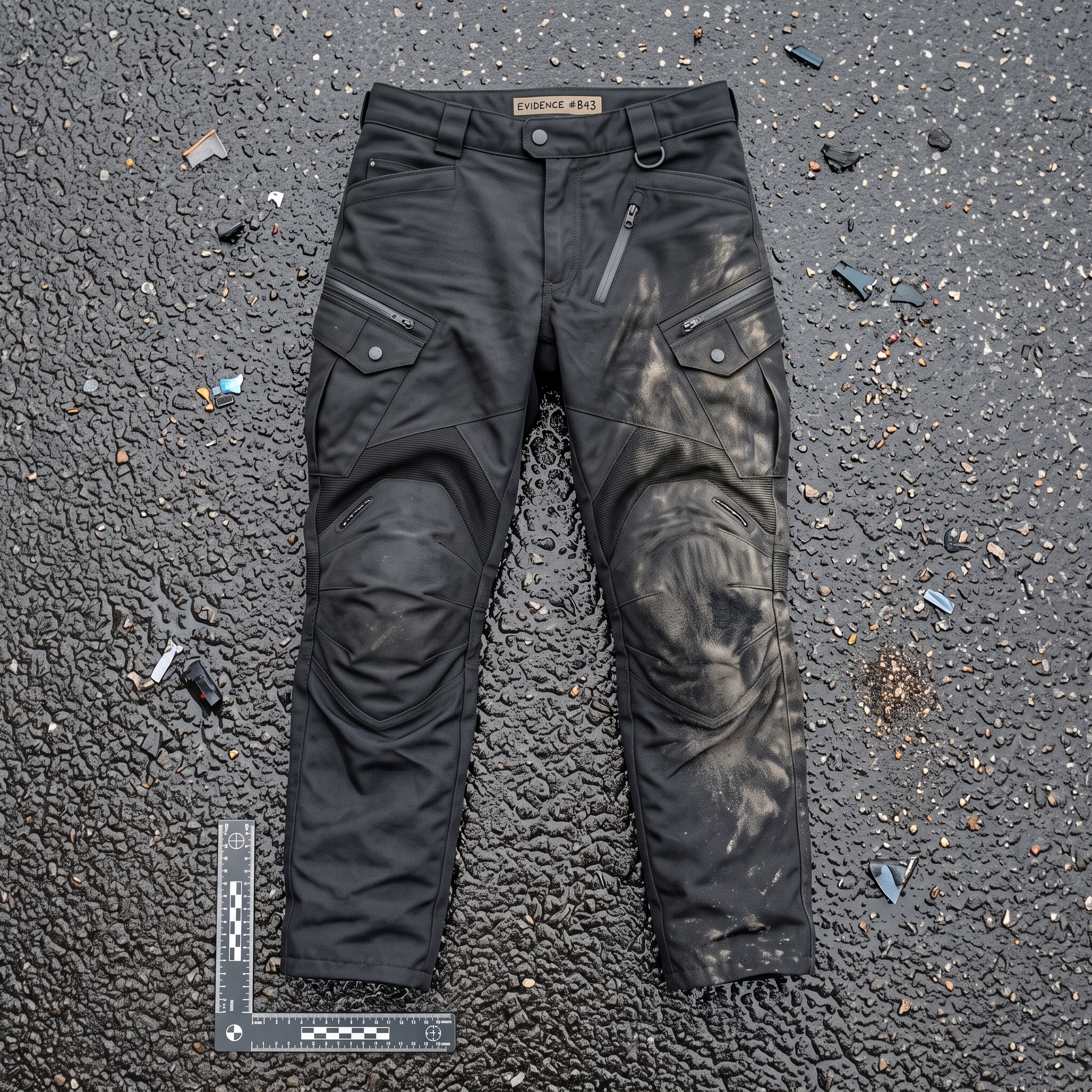
Scuffed. Held. Went back on the bike.
"Yeah, but armored jeans are hot and stiff."
They used to be. The old approach was a kevlar liner stitched inside ordinary denim — double-layered, heavy, "hot and a bit sticky," as one reviewer of a $350 pair admitted. Bastion uses a single-layer four-way-stretch shell instead: lighter, more breathable, and it bends where you bend. It stretches at the knee and waist, and only goes rigid where it matters — Cordura at the contact points, armor at the joints. Off the bike it walks "just like a normal jeans."
"I don't feel like I'm wearing bike gear."— Sam, verified rider review
And the part that really stings: the price
The market has trained you to believe protection costs a fortune. The respected AAA pairs sit at $350–$550. One reviewer shrugged that "$340 for something that will save your legs from getting torn apart is a small price to pay." He's not wrong — but he's also paying for a logo and a layer you don't need for city and A-road riding.
Bastion is genuine CE Class AA — the grade built for real-world speeds up to ~40 mph — from $69.99. Same job. A fraction of the price. And a free tactical belt in the box.
What's actually in them — and where it matters
From the outside, a Bastion cargo is deliberately boring: a clean, modern pant you'd wear to the office, the pub, or the school run without a second glance. The engineering is all on the inside, and it's placed exactly where a human body meets a road. Abrasion-resistant Cordura is built into the seat, hips and knees — the first three points that touch down in a slide. CE-rated armor sits in slim internal pockets at the knees and hips, the joints that take the impact. Everywhere else, it's four-way stretch, so it moves like a normal pant instead of a cast.
That placement is the entire point. You don't need a full leather race suit to survive a city commute — you need real protection at the points that actually make contact, in a garment you'll genuinely wear every single time. Gear that lives in the wardrobe because it's a faff protects nobody.
The real reason riders finally make the switch
It's almost never a statistic that does it. It's a story — a mate who came off, a near-miss on a wet drain cover, the morning you looked down at your jeans at a red light and quietly did the maths. Then the objection kicks in: "but I don't want to look like I'm off to a track day, and I don't want to spend four hundred quid." For most riders, that objection wins, and they keep gambling in denim for another season.
The reason Bastion owners switch and stay is that the objection simply evaporates. There is nothing to look past and nothing to talk yourself into. It looks like the pants you already own, it costs less than the excess on a decent bike insurance claim, and it happens to be certified to the exact grade built for the speeds you actually ride at. The decision stops feeling like a compromise — which is the only kind of safety decision people actually keep.
"Bought a pair for my husband who commutes daily. He wears them to the office now and nobody has any idea they're armored. He says they're more comfortable than his actual jeans."— Priya S, verified rider review
Will people be able to tell they're riding gear?
No — that's the whole design. Verified owners consistently say "nobody realizes they're not normal jeans." The armor is slim and internal.
Won't they be hot and stiff like other armored jeans?
Single-layer 4-way stretch, water-repellent. Bends where you bend; rigid only at the slide zones.
How is it this cheap if it's real CE AA?
$69.99 is a launch price (RRP $139.99). The CE EN 17092 certificate is published so you can verify the grade.
Is Class AA actually enough for everyday road riding?
Class AA under EN 17092 is the grade designed for real-world road speeds up to around 40 mph — city, commuting and A-roads. AAA adds margin for sustained high-speed and track use, at a much higher price and bulk most commuters never need.
What sizes are there, and do they run true?
XS–5XL. Owners report they fit like a slim-to-regular jean; if you're between sizes, the 4-way stretch is forgiving. There's a 30-day money-back if the fit isn't right.
Are they waterproof?
Water-repellent, not waterproof — they'll shrug off a shower and a damp commute, but they're built as protective everyday riding pants, not wet-weather over-pants.
This is an advertorial. Quotes are real rider verbatims from public reviews. Water-repellent, not waterproof.